
For the past few weeks, I’ve been sorting through multiple boxes filled with thirty years’ worth of old notes and manuscripts. To determine if a manuscript belongs in the “keeper” pile or the “toss” one, I have to review it. I’ve spent so much time reading old short stories and partially written novels that I’ve lost huge chunks of the day.
During this process, I uncovered a binder with three things inside: a letter, dated May 25, 1993, from the National Writers Club in Aurora, Colorado; a manuscript I submitted to their writer’s contest; and the judge’s critique.
The letter began like this: Congratulations on receiving Honorable Mention in the 1993 Novel Contest! Your certificate is enclosed.
Fun fact. I don’t remember entering this particular novel in their contest. And I have no idea what happened to the “enclosed certificate.”
The submission was a novel about an unborn soul and a living musician, destined to die, who tries to change his future. I remembered most of the plot, but not all of it. So I stopped everything to read it. Details are dated (it’s that old), but the story still surprised and entertained me. Since the novel didn’t win the contest, it made me wonder: Are authors allowed to enjoy their own work, warts and all?
That question reminded me of an incident from years and years ago, back when I belonged to a juggling club that practiced at a school gym in town. (Yeah, I used to juggle). All kinds of interesting people met on Saturday mornings to improve their juggling skills, including Russell, who could juggle ten rings while bouncing a soccer ball off his knees. What, you might ask, does this talented juggler have to do with writing? He was also a gifted playwright.
One weekend, a group of us carpooled to Philadelphia to watch one of his plays be performed at a theater in the city. We were blown away by the story and by the actors. In fact, one of the actors also acted in the first Alien movie. Possibly the android, but don’t hold me to it. Suffice it to say, he was well known at the time.
After the performance, the group of us who attended couldn’t wait to heap praises on Russell. He not only refused to accept our compliments; he stalked off so no one else could talk to him. Maybe he was simply a perfectionist, but his reaction was so negative, I still remember it all those years later, and I still wonder if I’m wrong for loving what I write.
On the one hand, if you don’t love your work, how can you expect readers to value it? If you hate it, why allow it to be performed in front of an audience?
On the other hand, you might think your story is so clever that you ignore fatal flaws in the plotline. You might even ignore constructive criticism.
Which brings me to a third hand: Maybe you don’t care if your story has problems. Nobody says you can’t write for yourself only. That way, you can love it and laugh along with it. Just don’t share it.
According to the judge, my 1993 contest entry needed work. Here is his conclusion: “You’ve done an excellent job of craftsmanship. But your story is missing an edge, something that sets it just slightly above and askew from other well-crafted, well-conceived formula stories. The edge and energy your story needs lie in twists of unpredictability, which in this case may mean bringing in a bit more of the cruelty and inexplicability of life and leaving it both cruel and inexplicable.”
At the bottom of that page (never to be seen by the judge), I handwrote: Personally, I don’t want to make it cruel and painful. There’s enough of that in real life.
That leads to another hand … (not a fourth hand?!). Choice. If you understand and accept that your novel needs some work, you can either dive in and make the changes or keep it as is and hide it away in your closet to review every ten or fifteen years as a lark.
Ultimately, I can’t say what I’ll do with my honorable mention novel, but for now, it’s still part of the herd. It’s not always easy to throw old manuscripts away.😊
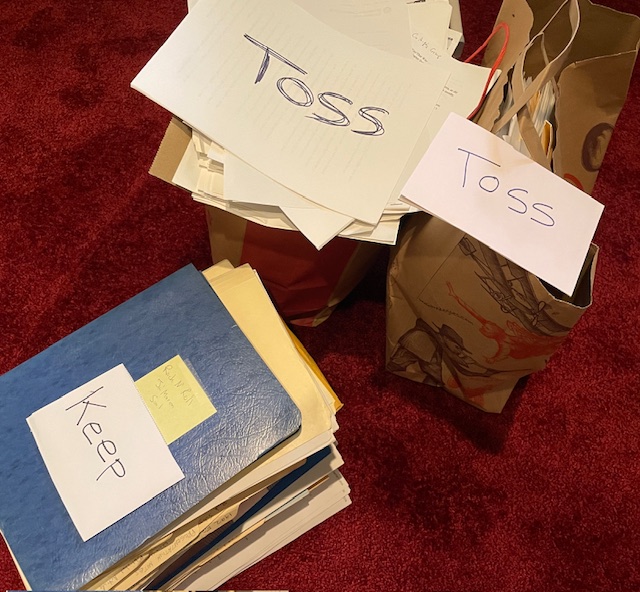
What about you? Do you keep all your “oldies,” or can you toss them?
Until next time, happy writing!